

Oktoberfest gives Australian brewers an opportunity to release traditional German and Bavarian-inspired beers at the beginning of spring.
Although Märzen is strongly associated with Oktoberfest, the modern festival is not represented by one beer alone. Pale Festbier is now the principal beer served at the event in Munich, while Märzen remains an important seasonal interpretation internationally. Bavarian wheat beers also provide a natural extension to an Oktoberfest range, bringing a more expressive fermentation profile and a useful contrast to clean, malt-forward lagers.
What’s the goal?
The central technical decision is not simply whether to brew an 'Oktoberfest beer', but which style best fits the intended drinking occasion, production schedule and available cellar capacity. Fermentation profile, attenuation, flocculation, diacetyl and sulphur management all influence whether the finished beer delivers the balance, clarity and drinkability expected from the category.
Before choosing a strain or finalising the grist, it helps to decide what role the beer will play. Will it be the brewery's main festival pour, designed for repeat serves and long sessions? A richer seasonal special? Or part of a small German-inspired range served across a taproom event?
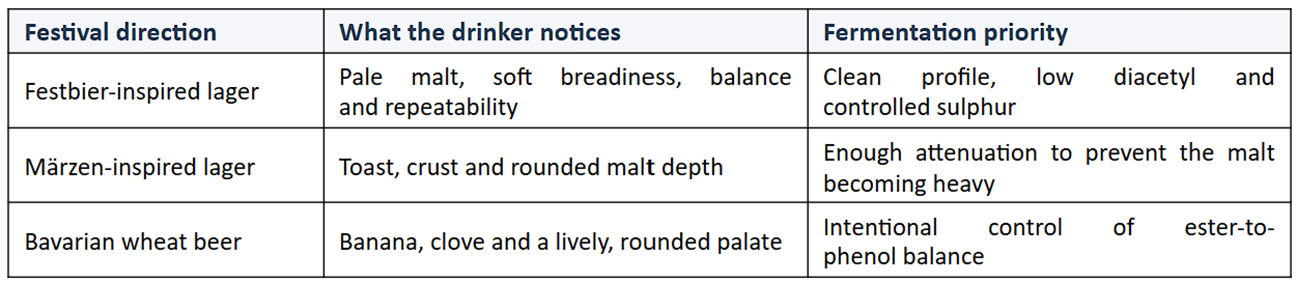
That decision changes the ideal fermentation character. A main festival lager usually benefits from a clean finish, restrained fermentation aroma and enough attenuation to keep the second pour inviting. A darker Märzen-inspired beer can carry more toast and bread crust, but still needs a controlled finish. A Weissbier, by contrast, earns its place through recognisable banana-and-spice fermentation character and a softer, more expressive palate.
Festbier and Märzen: Building Malt Character Without Heaviness
In a Festbier or Märzen-inspired beer, yeast should create the space in which malt and noble hops can shine through. The target is not a fermentation without character, but one whose character is expressed through smoothness, integration and a clean finish.
A strain such as FERMOLAGER Munich Heritage fits naturally enables this It is a Saccharomyces pastorianus strain selected in Bavaria and intended for traditional German and European lager styles. Its medium-high flocculation, 78-80% apparent attenuation and low ester, sulphur and diacetyl expression make it relevant where the brewer wants a clear malt backbone and defined noble-hop character without a distracting fermentation signature.
The advantage is versatility. The same fermentation platform can support a pale festival lager, Märzen, Dunkel or even a stronger Bock-style seasonal beer. For smaller breweries, that can make an Oktoberfest program easier to integrate into the production calendar without creating a one-off process for every tap.
Recipe and Fermentation Need to Work Together
A clean lager strain will not rescue an unbalanced recipe. A restrained addition of Munich or Vienna malt can provide bread and toast, while excessive crystal malt can turn a festival beer sweet and tiring. Likewise, bitterness need not dominate, but it should provide enough structure.
For Munich Heritage, the technical range is 10-14°C, with a direct-pitch recommendation of 75-100 g/hL. Within that window, consistency matters more than chasing a single 'perfect' temperature. Pitching enough healthy yeast in, avoiding abrupt temperature movement and allowing sufficient time for maturation will do more for the final beer than pushing the strain to accelerate the schedule.
Bavarian Wheat Beer: Making Fermentation Character the Focus
A Bavarian wheat beer offers a different kind of Oktoberfest appeal. It can be a practical option where lagering capacity is limited. FERMOALE Weiss is designed for this territory. This Saccharomyces cerevisiae strain combines medium-to-high banana esters with clove, pepper and nutmeg phenolics, at 78-82% apparent attenuation. That balance gives brewers a useful starting point, but the final expression remains highly responsive to process choices.
Managing Banana and Clove Expression
Fermentation temperature: moving toward the upper end of the strain's range generally favours more banana-like ester expression; cooler conditions support a more restrained profile.
Pitching rate: the lower end of the recommended range can encourage ester expression, while a more generous pitch tends to produce a steadier, less overtly fruity fermentation.
Aeration: lower aeration can push the beer toward a more ester-led profile, but this should be used carefully; yeast health and reliable completion still come first.
Original gravity: higher gravity can increase ester expression, while also raising the importance of adequate nutrition and fermentation management.
The strain's fermentation range is 16-24°C, with a direct-pitch recommendation of 50-80 g/hL into wort at 18-22°C. Those are useful boundaries, not a substitute for trials. Brewers should change one major variable at a time and retain sensory records, particularly when the desired distinction between banana and clove is central to the beer's identity.
Balancing Authenticity With Production Practicality
The most successful Oktoberfest-inspired beers are defined by balance: malt flavour without heaviness, fermentation character without roughness, and enough structure to remain interesting across a full glass. A clean Bavarian lager strain and an expressive Weissbier strain provide two different routes to that outcome. Used thoughtfully, they allow the brewer to shape a small seasonal range around contrast: one beer defined by restraint and malt clarity, the other by aromatic fermentation character. The products remain tools; the advantage comes from matching each tool to the intended drinking experience and controlling the process well enough for that intention to reach the consumer.
Technical note
Fermentation ranges, attenuation, pitch rates and strain characteristics in this article are based on the Australian technical datasheets for AEB FERMOLAGER Munich Heritage and FERMOALE Weiss. Brewers should assess requirements against their own wort composition, equipment, process conditions and quality program.

Ana Victoria Vasquez de la Peña
ana@neumaker.com.au

10th October 2025
© 2025 neumaker. All rights reserved. This article may be shared/forwarded for personal or educational purposes, provided it remains unaltered and includes proper attribution. Reproduction, distribution, or use in any other form—including but not limited to commercial purposes, republishing, or adaptation—without explicit written permission is strictly prohibited.