
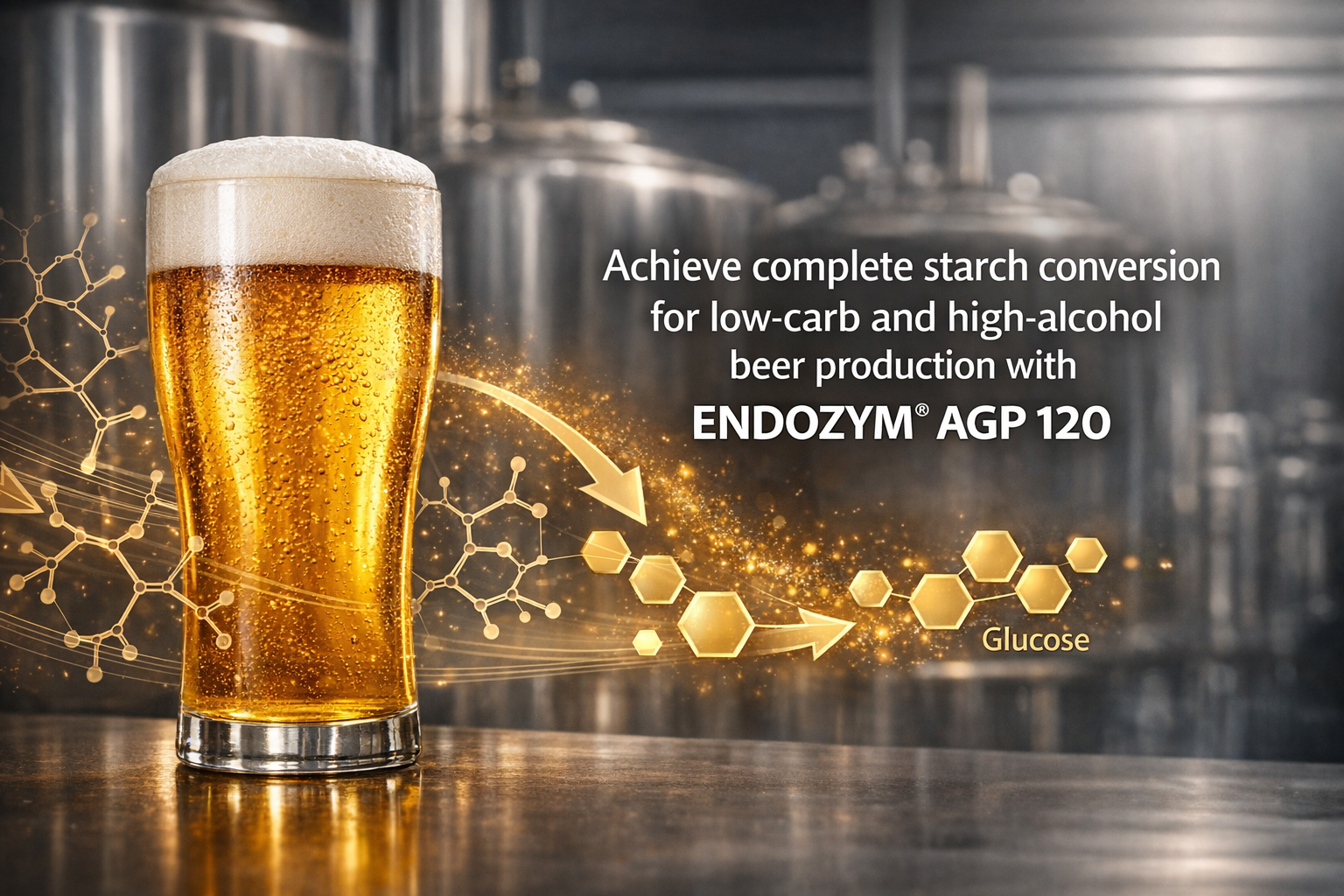
Achieve complete starch conversion for low-carb and high-alcohol beer production with ENDOZYM® AGP 120
Low-carb and high-alcohol beer styles both rely on the same production principle: increasing wort fermentability. The more completely starches and dextrins are converted into fermentable sugars, the easier it becomes to drive attenuation higher, reduce residual carbohydrate, and generate more alcohol from a given extract load. ENDOZYM® AGP 120 is a multi-enzyme complex designed to increase starch and dextrin conversion into fermentable sugars, ideal for low-carb and high alcohol beer production
Why fermentability is the real lever
In many beer styles, the limiting factor is not total extract, but how much of that extract remains locked in branched dextrins and other less fermentable carbohydrate fractions. This becomes especially relevant in formulations containing wheat, oats, dextrinous malts, or in process settings designed to preserve body and mouthfeel. In these cases, a portion of the carbohydrate load can remain less accessible to yeast, limiting attenuation and leaving behind more residual carbohydrate than desired.
ENDOZYM® AGP 120 addresses this challenge through a broader enzymatic profile than a single-function glucoamylase ap
proach. Amyloglucosidase acts on both α-1,4 and α-1,6 linkages, helping release glucose units from starch-derived substrates. At the same time, α-amylase reduces longer starch chains into smaller fragments, while pullulanase opens branch points in amylopectin so hydrolysis can proceed more completely. This complementary activity supports a more thorough breakdown of complex carbohydrates and results in a more fermentable wort.
For brewers targeting low-carb beer styles, this is particularly valuable. Improved dextrin breakdown helps reduce the carbohydrate fraction that would otherwise remain in the finished beer, while also supporting a drier palate and cleaner finish. Rather than simply increasing alcohol yield, the enzyme system helps reshape the fermentability profile of the wort in a way that better aligns with the requirements of highly attenuated, low-residual-carb beers.
Managing Temperature for Flavour Expression
The same mechanism that supports low-carb beer production also creates value in high-alcohol brewing. Once a greater proportion of the wort carbohydrate fraction is converted into yeast-available sugars, fermentation has more usable substrate to convert into ethanol. This gives brewers a more efficient route to higher ABV from mash-derived extract, rather than relying too heavily on simple sugar additions to build strength.
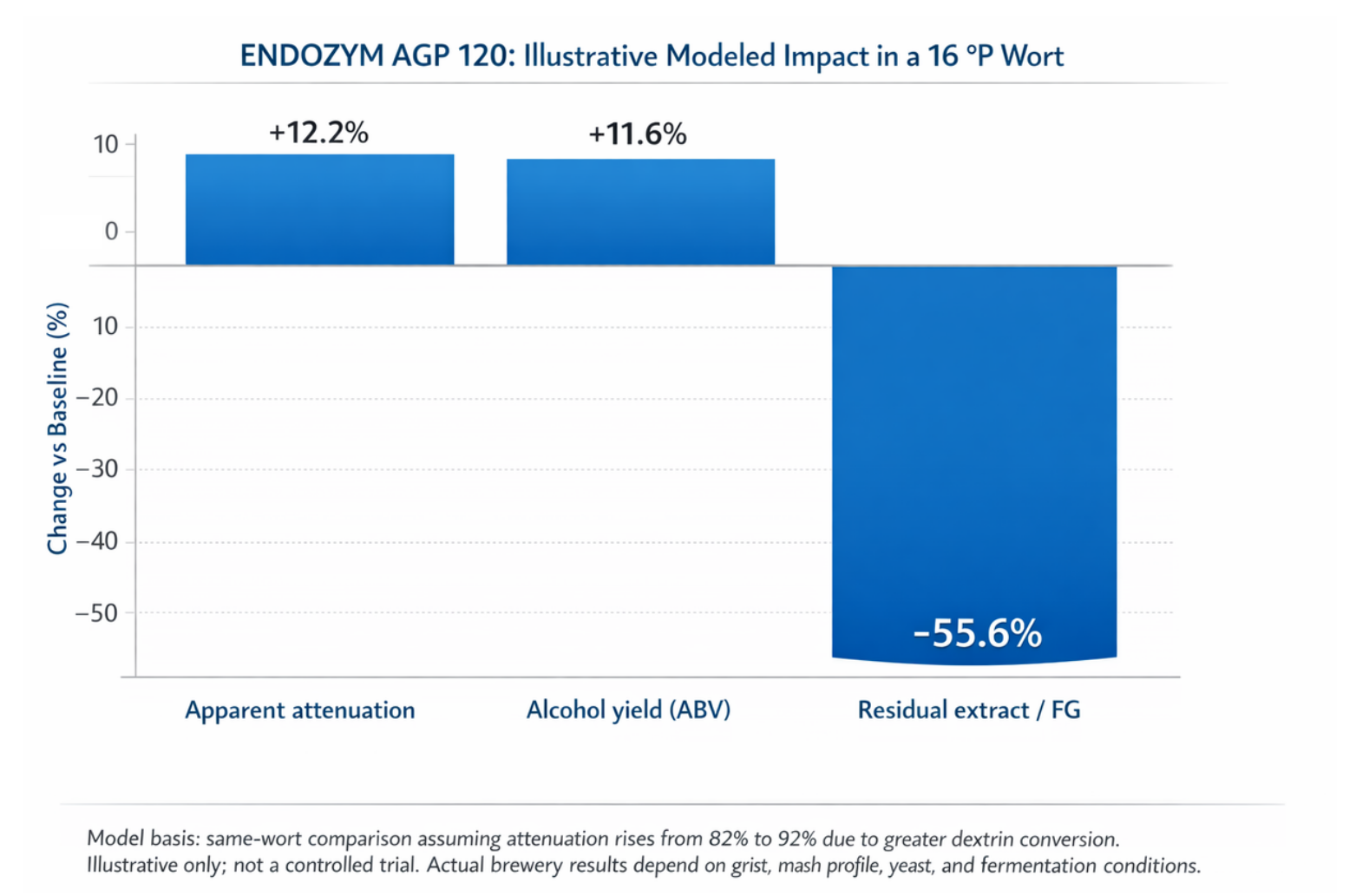
This can be particularly useful in strong beer production, where achieving elevated alcohol levels while maintaining balance is often a challenge. If too much of the wort remains unfermented, the beer can finish with excessive sweetness, heavier body, and less drinkability than intended. By improving the conversion of starches and branched dextrins into fermentable sugars, ENDOZYM® AGP 120 helps brewers push attenuation further and produce stronger beers with a drier, more controlled finish.
In this sense, ENDOZYM® AGP 120 is not only an attenuation tool, but also an extract-efficiency tool. It helps brewers make better use of cereal-derived extract, improve alcohol yield potential, and produce beers that are either lower in residual carbohydrate, higher in alcohol, or both, depending on the target style and process design.
Practical brewing applications
ENDOZYM® AGP 120 is particularly valuable in brewing applications where high fermentability is a defined production target. This includes low-carb lagers, brut-style beers, and other highly attenuated styles where brewers are aiming to reduce residual carbohydrate and deliver a drier finish. It is also relevant in high-alcohol beer production, where increasing the proportion of wort-derived sugars available to yeast can help build ABV more efficiently from mash-derived extract.
The enzyme system can also offer advantages in grists containing wheat, oats, or dextrinous malts, where a greater share of the carbohydrate fraction may otherwise remain less fermentable. In these formulations, ENDOZYM® AGP 120 helps improve the breakdown of complex starch structures and branched dextrins, supporting a wort composition that is better suited to complete fermentation. This gives brewers greater flexibility when designing beers that need to balance attenuation targets with specific raw material choices or mouthfeel objectives.
In practical terms, this makes the product useful not only for creating low-carb beers, but also for supporting recipe and process designs where brewers want to push fermentability beyond what mash parameters alone may achieve. Whether the goal is a crisp low-carbohydrate lager or a strong beer with less residual sweetness, ENDOZYM® AGP 120 supports more controlled and style-aligned fermentation performance.
Process efficiency and extract utilisation
In highly attenuated brewing, process efficiency is not only determined by how much extract is produced in the brewhouse, but by how much of that extract can actually be metabolised by yeast during fermentation. A wort may contain sufficient extract on paper, but if a meaningful portion remains tied up in branched dextrins and other less fermentable carbohydrate fractions, part of that potential remains inaccessible. This can limit both final attenuation and the efficiency with which wort solids are converted into ethanol.
ENDOZYM® AGP 120 helps improve extract utilisation by increasing the proportion of starch- and dextrin-derived material that is converted into fermentable sugars. By combining amyloglucosidase, α-amylase, and pullulanase activities, the enzyme system acts across a broader range of carbohydrate structures than a single-enzyme approach, supporting more complete hydrolysis of complex starch fractions. The result is a wort in which a greater share of the carbohydrate load is available for fermentation.
From a process perspective, this gives brewers a more efficient route to their target outcome. In low-carb beer, that means reducing the amount of residual carbohydrate carried through into the finished product. In high-alcohol brewing, it means improving the proportion of mash-derived extract that can be converted into ethanol, which may reduce the need to rely heavily on simple sugar additions to achieve strength. In both cases, ENDOZYM® AGP 120 supports more effective use of brewhouse extract and helps align fermentation performance more closely with production goals.

Ana Victoria Vasquez de la Peña
ana@neumaker.com.au

10th October 2025
© 2025 neumaker. All rights reserved. This article may be shared/forwarded for personal or educational purposes, provided it remains unaltered and includes proper attribution. Reproduction, distribution, or use in any other form—including but not limited to commercial purposes, republishing, or adaptation—without explicit written permission is strictly prohibited.