
New ALDC Enzyme is now available from neumaker
ALDC Enzyme provides brewers with a direct way to reduce diacetyl formation by converting alpha-acetolactate into acetoin before diacetyl can develop. It can help make maturation more predictable and release valuable cellar capacity.
Diacetyl control is familiar territory for brewers, but it remains one of the points at which an otherwise complete fermentation can continue to occupy tank space. Gravity may be stable, attenuation may be on target and the beer may appear ready to move, yet residual precursor means additional warm maturation is still required before the beer can be cooled and released.
That delay is not simply a flavour issue. It affects tank availability, production scheduling, refrigeration demand and the confidence with which packaging dates can be set. neumaker has introduced a liquid ALDC Enzyme for breweries looking to manage that part of fermentation more strategically.
Why diacetyl can remain after fermentation appears complete
Diacetyl is one of the best-known vicinal diketones in beer. At elevated concentrations it contributes buttery, butterscotch or popcorn-like notes that are generally undesirable in clean lagers, pale ales and many contemporary beer styles. Its sensory threshold is low, particularly in lightly flavoured beer, which means relatively small concentrations can become noticeable.
The important point is that yeast does not release all diacetyl directly. During valine biosynthesis, yeast produces alpha-acetolactate. Some of this precursor can leave the cell and enter the fermenting beer. Outside the cell it can undergo oxidative decarboxylation to form diacetyl.
Healthy yeast can subsequently take up diacetyl and reduce it through acetoin to 2,3-butanediol. This natural clean-up process is the basis of the traditional diacetyl rest. However, it takes time and depends on maintaining sufficient active yeast, an appropriate temperature and suitable fermentation conditions.
What ALDC changes in the pathway
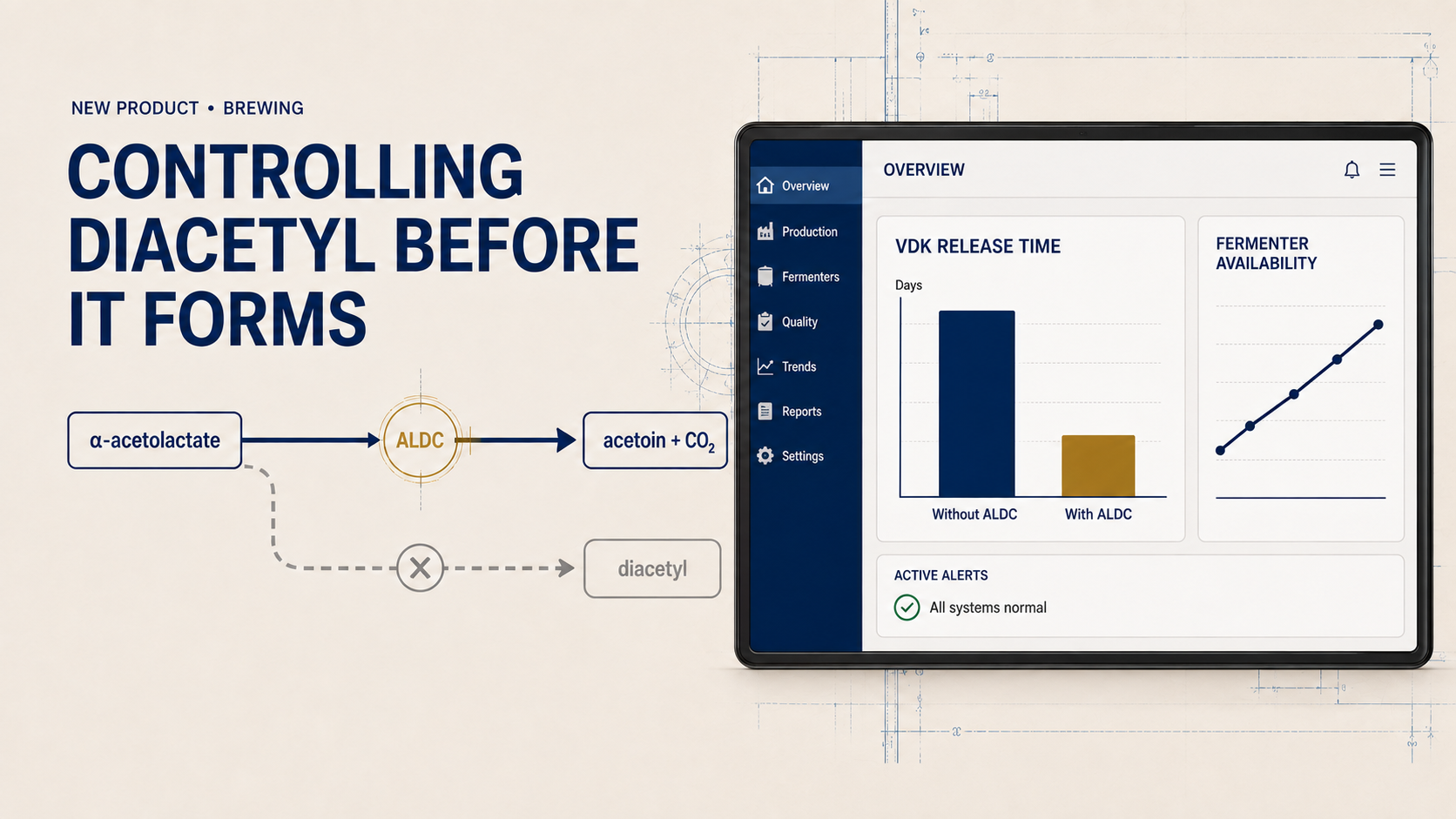
Alpha-acetolactate decarboxylase, usually shortened to ALDC, acts on the precursor rather than waiting for diacetyl to form. It catalyses the direct, non-oxidative conversion of alpha-acetolactate into acetoin and carbon dioxide:
alpha-acetolactate → acetoin + CO₂
Acetoin has a substantially higher flavour threshold than diacetyl. Redirecting the precursor through this pathway therefore reduces the amount of diacetyl that needs to be removed by the yeast later in fermentation. Rather than accelerating yeast uptake of existing diacetyl, ALDC works primarily as a preventive control.
That distinction matters. ALDC does not convert free diacetyl already present in the beer. If a fermentation has elevated diacetyl because of yeast stress, contamination, premature yeast removal or poor maturation management, the root cause still needs to be addressed. The strongest application is early addition, while precursor is being produced.
Where the efficiency comes from
The commercial value of ALDC is not simply a lower diacetyl result. Its main contribution is the possibility of removing variability from one of the final rate-limiting stages of fermentation.
More predictable maturation
VDK clearance can make the end of fermentation difficult to schedule. By limiting the amount of diacetyl formed, ALDC can reduce dependence on a prolonged warm rest and make the point at which beer is ready for cooling more consistent from batch to batch.
Improved fermenter utilisation
A day saved in maturation is a day in which a fermentation vessel can move closer to its next fill. For breweries operating near cellar capacity, shortening or stabilising the maturation phase can increase practical throughput without immediately adding tanks. The size of the benefit will depend on the current process: breweries already achieving rapid, consistent VDK clearance may see less gain than sites where diacetyl regularly holds beer in tank.
Reduced energy and scheduling pressure
When a warm maturation period can be shortened, the associated heating, holding and subsequent cooling load may also be reduced. More importantly, packaging plans become less exposed to a late VDK result that forces a beer to remain in tank beyond its intended release date.
Application and dosage
Neumaker recommends a typical dosage rate of 1.0–1.5 g/hL, with 1.5 g/hL providing a practical starting point for brewery trials. Add the enzyme to cooled wort during transfer to the fermenter, or immediately before or alongside yeast pitching. Normal wort movement during transfer should provide even distribution.
The effective dose can vary with enzyme activity, wort composition, yeast strain and condition, fermentation temperature, pH and the brewery’s target VDK specification. ALDC products should therefore not be compared on dosage alone. A higher addition rate does not necessarily indicate a stronger process, and rates used for one commercial formulation should not automatically be transferred to another.
The enzyme should not be added to hot wort. Store the product refrigerated at 4–10°C, protect it from direct sunlight and do not freeze. As with any enzyme preparation, avoid generating aerosols or mist during handling and follow the applicable safety documentation.
Verification still matters
ALDC can reduce the formation of diacetyl, but it does not remove the need for brewery release criteria. Gravity, temperature and time alone do not confirm that a beer is free of precursor risk. Forced-diacetyl testing or laboratory total-VDK analysis should continue to be used when shortening an established maturation schedule.
ALDC Enzyme is now available from neumaker
For breweries, the opportunity is big: reduce the amount of diacetyl that needs to be cleaned up later, then use verified production data to determine whether maturation time can be shortened safely. The result may be a cleaner release profile, more predictable scheduling and better use of existing cellar capacity.

Ana Victoria Vasquez de la Peña
ana@neumaker.com.au

10th October 2025
© 2025 neumaker. All rights reserved. This article may be shared/forwarded for personal or educational purposes, provided it remains unaltered and includes proper attribution. Reproduction, distribution, or use in any other form—including but not limited to commercial purposes, republishing, or adaptation—without explicit written permission is strictly prohibited.